Archives For Seattle

News & Notes

gcpvd —  May 24, 2013 — Leave a comment

seattle-times-bridge→ The Seattle Times: ‘Miracles’: 3 survive I-5 collapse

A chunk of Interstate 5 collapsed into the Skagit River near Mount Vernon on Thursday evening, dumping two vehicles into the icy waters and creating a gaping hole in Washington state’s major north-south artery.

Rescuers pulled three people with minor injuries from the water after the collapse, which authorities say began when a semitruck with an oversized load struck a steel beam at around 7 p.m.

That caused a massive piece of the northern side of the bridge to wobble, and then fall into the water, taking with it a gold pickup, its travel trailer and an orange SUV.


But actually, our infrastructure crisis is a myth…

→ Bloomberg: The Myth of the Falling Bridge

Maybe it’s going too far to say, “The U.S. is doing just fine, thank you very much.” The nation would benefit from reordering its infrastructure priorities — away from new highways, for example, where we are already overbuilt and usage is falling for the first extended period on record. And we’d do well to take advantage of low interest rates and idle construction resources to knock out all of our future infrastructure needs.

But the idea that the U.S. has an infrastructure crisis? No. A broad, permanent increase in spending is unwarranted.

Continue Reading…

The Seattle Transit Blog reports that Amazon.com, which is building a shiny new headquarters complex in Downtown Seattle, plans to buy that city a new streetcar vehicle for service on an existing line and provide funding for shorter headway service.

The overall proposal includes $5.5 million of support for the Seattle Streetcar. This funding will allow the City to purchase an additional streetcar vehicle and increase operational support for 10 years as a part of the Planned Community Development benefit package. In total, these benefits will increase street car service to every ten minutes during the workday.

They will also be building other pedestrian and cycling enhancements in the area. Apparently all this is in exchange for the taking of a number of public alleys the company needs to construct it’s headquarters.

Imagine if we called on developers to give concessions to receive zoning variances and street abandonments.

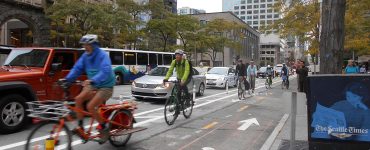
Nickerson Street in Seattle

Image from Seattle.gov

The City of Seattle has released a report that their experiments with rechannelizing (i.e. putting the road on a diet) that city’s Nickerson Street has resulted in improved safety.

Completed by the City in August 2010, the modifications have produced the following results:

  • Reduced collisions by 23 percent over a one-year period (compared to the previous five-year average)
  • Motorists traveling over the speed limit have declined by more than 60 percent
  • Top-end speeders (people traveling 10 or more miles over the speed limit) have fallen by 90 percent
  • The 85th percentile speed dropped from 40 mph and 44 mph westbound and eastbound to 33 mph and 33 Westbound and Eastbound. This is an 18 and a 24% reduction in speed.
  • Traffic volumes remain roughly the same with no evidence of traffic diversion.

So LIKE for street safety and LIKE for Nickerson Street being a safer place now!

News & Notes

gcpvd —  November 25, 2011 — Leave a comment

Seattle Sharrows - 1 of 8

Sharrows on a Seattle Street, Photo (cc) The Prudent Cyclist.

News & Notes→ Sharing time: Tracking the ‘sharrow’ on city streets [Grist]

Like many experts on transportation bicycling, Fucoloro wasn’t enthusiastic about them. Sharrows are spread so indiscriminately on Seattle streets, he said, that “they mean nothing now.” He has noticed that there seems to be “slightly less aggression” from drivers when they’re in place. “But does that mean all the streets without sharrows are worse?”

In other words, with sharrows everywhere, do drivers assume that cyclists don’t belong on streets without them?


→ Five myths about your gasoline taxes [CNN]

A perpetual deadlock in Congress has resulted in eight extensions of the national transportation bill, causing roads to crumble, bridges to fall, and transit to break down.

Come March 2012, politicians will once again enter into a political debate about funding American mobility. Without a fiscal safety net in place, the Highway Trust Fund will go broke.


Continue Reading…

This 1940 film tells the story of the removal of Seattle’s streetcars in favor of buses and trackless trolleys, rail to rubber. Flashforward 60 years and the city is putting streetcars back.

News & Notes

gcpvd —  September 19, 2011 — 1 Comment

→ In wake of Ohio River bridge closure, NBC Nightly News examines the sorry state of U.S. bridges [Transportation for America]

Visit msnbc.com for breaking news, world news, and news about the economy

Over the weekend, NBC Nightly News ran a sharp piece on our country’s structurally deficient bridges, focusing on the data in the T4 America bridge report.

At least one person somewhere in the U.S. is driving over a structurally deficient bridge, according to T4 America director James Corless in a report on the woeful condition of our nation’s bridges on NBC Nightly News Sunday evening.

Brought into the national spotlight because of the recent closure of a highly-trafficked interstate bridge over the Ohio River in Louisville, Kentucky and the President’s scheduled appearance at a Cincinnati-area bridge this Thursday, more national media outlets (and Americans and their leaders in Congress, one would hope) are paying attention to the real-life impacts of underinvestment in infrastructure.


→ Debunking the Cul-de-Sac [The Atlantic Cities]

This is where it’s most apparent – from an airplane window – that American ideas about how to live and build communities have changed dramatically over time. For decades, families fled the dense urban grid for newer types of neighborhoods that felt safer, more private, even pastoral. Through their research, Garrick and colleague Wesley Marshall are now making the argument that we got it all wrong: We’ve really been designing communities that make us drive more, make us less safe, keep us disconnected from one another, and that may even make us less healthy.


Continue Reading…

News & Notes

gcpvd —  June 14, 2011 — 1 Comment

→ A Stupid Attack On Smart Growth [Planetizen]

The National Association of Home Builders (NAHB) has a well-financed campaign to discourage communities from considering smart growth as a possible way to conserve energy and reduce pollution emissions. They contend that compact development has little effect on travel activity and so provides minimal benefits. The NAHB states that, “The existing body of research demonstrates no clear link between residential land use and GHG emissions.” But their research actually found the opposite: it indicates that smart growth policies can have significant impacts on travel activity and emissions.


→ Most Aging Baby Boomers Will Face Poor Mobility Options [Transportation for America]

By 2015, more than 15.5 million Americans 65 and older will live in communities where public transportation service is poor or non-existent, a new study shows. That number is expected to continue to grow rapidly as the baby boom generation “ages in place” in suburbs and exurbs with few mobility options for those who do not drive.

The report, Aging in Place, Stuck without Options, ranks metro areas by the percentage of seniors with poor access to public transportation, now and in the coming years, and presents other data on aging and transportation.


Continue Reading…

News & Notes

gcpvd —  December 9, 2010 — Leave a comment

→ Apartments, stores planned on Loyola Avenue near Superdome [The Times-Picayune]

Spurred by the future Loyola Avenue streetcar line, a local development firm plans to transform a sea of downtown [New Orleans] parking lots into 450 apartments and 125,000 square feet of shops and restaurants that it calls the South Market District.

Jewelry District, this is your fuiture.

→ In Quest for Revenue, Cities Turning to PILOTs [CitiWire]

“PILOTs can provide crucial revenue for certain municipalities, and are one way to make nonprofits pay for the public services they consume,” Kenyon and Langley say. “However, PILOTs are often haphazard, secretive, and calculated in an ad hoc manner that results in widely varying payments among similar nonprofits. In addition, a municipality’s attempt to collect PILOTs can prompt a battle with nonprofits and lead to years of contentious, costly, and unproductive litigation.”

→ Moving an Interstate highway [Let's Go KC]

In recent months a movement has started to relocate I-35 from Downtown to the West Bottoms, undoing one of the city’s worst 1950s-era highway mistakes. MoDOT is planning to rehab the aging section between the state line and Downtown Loop, and several neighborhoods have seized the opportunity to broaden the conversation to include the idea of moving the freeway instead of rebuilding it.

Been there, done that.

→ No Free Parking [Physics Central]

Next time you’re searching for a parking space and someone grabs a spot from right in front of you, it might seem like the last space left on Earth, but ponder this: there are at least 500 million empty spaces in the United States at any given time.

The researchers extrapolated on a rule of thumb used by urban planners that claims eight parking spaces exist for every one car. The group says that there is little science to support this scenario, but the result would be a whopping 2 billion parking spaces. If all of those spots were consolidated into a single location they would cover an area the size of Massachusetts. The most likely scenario calls for about half that area in parking spaces.

→ seattle: quick notes on “rapid ride” [Human Transit]

Looks to be a lot like RIPTA’s proposed Rapid Bus [.pdf] service.

Seattle stole my snow!

Jef Nickerson —  November 24, 2010 — Leave a comment

Seattle doesn’t get very much snow, but they had an early winter storm hit them this week. Drivers on John Street in the Capital Hill section of town were none to happy about it.

Skip to the 2:43 mark to see a city bus try to go down the hill (well, it goes down, but not as intended).

Via: Human Transit

News & Notes

gcpvd —  October 7, 2010 — Leave a comment

→ Rail Service Expansion Imperiled at State Level [The New York Times]

“Any notion that somehow rail is subsidized, and other modes of transportation aren’t, is simply not factual,” said Mr. Smith, the president Reconnecting America, a nonprofit transportation advocacy group, who noted that highways and airports were subsidized as well. “Honestly, transportation infrastructure should not be a partisan issue. When you talk about good transportation solutions, they cross party lines.”

→ The Rise of the Bus-Riding Celebrity? [GOOD]

→ A Massive Facelift for Eastern Germany [Spiegel Online]

During a trip to East Germany in 1990, photographer Stefan Koppelkamm discovered buildings that had survived both the war and the construction mania of the East German authorities. Ten years later, he returned to photograph the buildings again. The comparison threw up some unexpected contrasts.

Visit the Berlin Interactive Graphic and the Photo Gallery.

→ Vacant Fox Point industrial buildings put on the auction block [Providence Business News]

Former home of Bevo on South Main Street

→ Why All the Outrage Over Bike Boxes? [publicola]

Perhaps even more than “road diets,” which replace driving lanes with bike lanes and add a turn lane for cars, the bike boxes have brought out anti-bike, pro-car contingent, which argues that it’s unfair to make drivers wait for cyclists at red lights.

From the cyclist’s point of view, of course, this is an asinine argument. First, the primary point of bike boxes is to make cyclists more visible to drivers. When drivers hit cyclists—and yes, cyclists do frequently get hit in right-hook accidents by inattentive drivers—the inevitable refrain is, “I didn’t see her!” Bike boxes make drivers more likely to see us.

We suggested a Bike Box at the Point Street and South Water Street intersection where the Wickenden Street overpass used to be, when the street is rebuilt.

→ Rhode Island roads need $4.5 billion investment over next decade, report says [Providence Business News]