Archives For Rail

nec_study_area_map

Federal Railroad Administration is running a planning program of future needs along the Northeast Corridor rail system and encourages public input:

Welcome to NEC FUTURE, a comprehensive planning effort to define, evaluate and prioritize future investments in the Northeast Corridor (NEC), launched by the Federal Railroad Administration (FRA) in February 2012. FRA’s work will include new ideas and approaches to grow the region’s intercity, commuter and freight rail services and the completion of an environmental evaluation of proposed transportation alternatives.

The NEC, the rail transportation spine of the Northeast region, is a key component of the region’s transportation system and vital to its sustained economic growth. Today, the 457-mile NEC—anchored by Boston’s South Station in the north, New York’s Pennsylvania Station in the center, and Washington’s Union Station in the south—is one of the most heavily traveled rail corridors in the world.

Visit NEC Future to submit your comments.


See also: ProJo: Agency explores methods to expand rail service to D.C.

Fast Lane: Obama Administration says “We Can’t Wait,” tells states to use idle earmarks to improve transportation and put people to work

At DOT, we know that America’s transportation infrastructure is in need of attention, while construction workers across the country remain eager to get back on the job repairing, replacing, and modernizing our roads, rails, and runways.

Over the last decade, Congress has set aside $473 million in transportation funds that were never spent. These idle earmarks have sat on the shelf as our infrastructure continues to age and fall into disrepair, and hundreds of thousands of construction workers look for work. That ends today.

I’m excited to announce that this Administration is freeing up this unspent money and giving it right back to the states so that they can spend it on the infrastructure projects they need most.

As President Obama said today, “My administration will continue to do everything we can to put Americans back to work. We’re not going to let politics stand between construction workers and good jobs repairing our roads and bridges.”

News & Notes

gcpvd —  November 30, 2011 — 1 Comment

Fare Box

Photo (cc) Nick Bastian

News & Notes→ Make bus service free [New Urbanism Blog]

It’s true. Nothing is ever free. But my proposition is that the basic city bus service that so many places fund would be better off as a basic municipal service, like fire or police. Fund it through a dedicated tax of some kind – sales, property, etc, and don’t bother to charge for the ride itself. Allow me to elaborate.


→ The bike whisperer [RedEye Chicago]

The wheels of change are in motion for city cyclists thanks to new initiatives from [Chicago] Mayor Emanuel. In the works are 100 miles of protected bike lanes, increased bike parking and a widespread bike-share program that could put Chicago on the map as one of the nation’s most bike-friendly cities.

Enter Gabe Klein, the city’s Department of Transportation commissioner, who took office this year.


Continue Reading…

News & Notes

gcpvd —  August 30, 2011 — 1 Comment

→ Pictoral> MTA Perseveres Through Hurricane Irene [The Architect's Newspaper]

The Architect’s Newspaper looks at how the New York transit system faired during Irene. More photos, such as the one below, on the MTA’s Flickr page.

046

Photo (cc) MTAPhotos

Also see, Metro-North and the Aftermath of Irene, Damage Photos via I Ride the Harlem Line


→ Blackstone River Regional Rail [Pedestrian Observations]

Following up on my proposal for improving regional and intercity rail service between Providence and Boston, let me propose a line from Providence to Woonsocket, acting as an initial line of a Providence S-Bahn. The basic ideas for how to run a small-scale regional railroad, as usual, come from Hans-Joachim Zierke’s site, but are modified to suit the needs of a line with a larger city at one end. It is fortunate that the road connecting the two cities is not a freeway, and takes 24 minutes, allowing good transit on the same market to be competitive.

Continue Reading…

News & Notes

gcpvd —  May 11, 2011 — 1 Comment

→ Would $12,000 Convince You To Move Closer To Work? [Fast Company]

How much cash would it take to get you to move closer to your work? For the purposes of this exercise, imagine that your work is in one of the more, shall we say, unsavory parts of Washington, D.C. and you live in a nice, quaint suburb in Virginia. Would you accept $12,000? Washington, D.C.’s Office Of Planning thinks you might–so the organization is launching a pilot program that will match employer contributions of up to $6,000 to convince people to move closer to their work or public transit.


→ A mighty role in downtown Worcester [Boston.com]

WORCESTER – Stand on one side of tiny, wedge-shaped Federal Square, on the southern edge of this city’s downtown, and the perspective is gleaming. What once was a boarded-up multiplex is now the glassy facade of the restored Hanover Theatre for the Performing Arts, a venue for touring Broadway shows that draws audiences from all over fast-growing Worcester County.

Stand on another side of the square, and the pawnshop that doubles as a check-cashing emporium is difficult to miss, while empty storefronts are easy to see. Then again, the dive bar is gone now, replaced by an establishment that serves craft beers. Apartments a few doors down from the theater are being rehabbed. A couple of small restaurants have popped up.

Continue Reading…

News & Notes

gcpvd —  March 16, 2011 — Leave a comment

→ Making Sense of Amtrak’s Vision for the Northeast [The TransportPolitic]

Let it be known: Amtrak’s focus is on the Northeast Corridor. While Congress may require it to provide long-distance, cross-country services, the public company owns most of the rail corridor between Boston and Washington and it intends to exploit it fully… If it gathers sufficient resources to do so.


→ More Vehicles Than People [Planetizen]

Historic Massachusetts towns have reached a new milestone — the number of vehicles on the road have outnumbered the population of people. Ann Sussman looks at this “demographic” shift, and what it means for people living in the shadow of Emerson and Thoreau.

Continue Reading…


Mad Men On Trains from Rich Sommer

This video has been all over the interwebs today, so it should be here too. Two characters from the Mad Men series discuss the idea of advertising high speed trains (in 1965).

“I think you can relax on this whole thing. I read a piece that said that in 40 years gas is going to be almost a dollar a gallon,” says Harry. “Look cities are getting bigger. Trains are the most efficient, economical, best investment. It’s obvious. We do not need to sell trains.” “I suppose you’re right again,” says Pete. “I know I’m right,” says Harry, “Now are you going to fix me a drink? I’ve got a long drive home.”

Via: America2050

News & Notes

gcpvd —  March 2, 2011 — Leave a comment

→ Sidewalk Rage: Mental Illness or ‘Altruistic Punishment?’ [Time Magazine | Healthland]

While it sounds like an oxymoron, altruistic punishment is basically how social norms get enforced. So when you expel a huffy “Excuse me!” to the rude sidewalk clogger in front of you who has stopped midstride to check his BlackBerry, you’re trying to discourage behavior that endangers other members of the society. It’s called “altruistic” punishment, because your efforts to protect civility come at personal cost with little chance of personal benefit: you are far more likely to get an obscene gesture or even a punch in the mouth than a thank you.


→ Nonprofit group wins funds for Olney Village rehab project [The Providence Journal]

Olneyville Housing Corporation has received key financing assistance from Rhode Island Housing that will permit the nonprofit organization to move forward with its Olney Village project.

The $10-million development project will turn 11 foreclosed properties and a large vacant lot in the Providence neighborhood into 39 affordable apartments, plus spaces for two organizations: the food pantry formerly located at St. Teresa’s Church and the Manton Avenue Project, a youth arts and theater program.


Continue Reading…

ProJo Video: Interlink opening

gcpvd —  October 29, 2010 — 4 Comments

Video from The Providence Journal.

News & Notes

Jef Nickerson —  October 19, 2010 — 3 Comments

→ Footbridge an elegant new icon in East Bay [SFGate]

The 600-foot-long arc not only eases the way for pedestrians and bicyclists, it also sends a message naysayers choose to ignore: our society should aim to produce civic works on par with cherished landmarks from the New Deal or the Carnegie libraries of the generation before that.

This larger cultural role is what civic infrastructure can achieve when built with ambition and the long-term view. Contra Costa’s Redevelopment Agency deserves credit for pulling together the funding from county, state and federal sources.

The word “icon” is used far too often in architectural hype. But at its own modest scale, Robert I. Schroder Overcrossing shows what an icon can be. You don’t expect to see it; once you do, you’re glad it’s there. And you look forward to seeing and experiencing it again.

→ American Planning Association 10 Best Public Spaces of 2010 [American Planning Association]

Maybe someday Kennedy Plaza will make the list.

→ Rio to Open Urban Gondola System This Year [The Gondola Project at Creative Urban Projects]

Peter Brassard touched upon aerial trams, or gondollas, in his recent post and here is another urban system to add to the list in Brazil. As Rio prepares to host the Olympics in 2016(?) this is one of the infrastructure projects they have been working on.

In this article I even learned a new term, CPT meaning Cable Propelled Transit system. Add that to the lexicon of BRT, LRT, TOD, and other transit acronyms.

→ Shared Space-Harvard Square-Woonerf Streets [Public Space Project and Lincoln Institute of Land Policy]

But in Europe, designers are taking it a step further – removing traffic signals and signage altogether, relying on the human ability to adapt and communicate with other drivers and pedestrians by entering an intersection or traveling down a street and figuring it all out. It’s a counter-intuitive notion to be sure, based in the Dutch concept of the “woonerf,” a street that eliminates the strict separation of uses and instead invites a civil set of ad-hoc rules and eye contact. Woonerfs are all around us – the valet area in front of a hotel, or the parking lot in front of Target. Everybody slows down because there is an obvious mix of parking and getting out of cars and moving around on foot.

I mention woonerfs here from time to time and at some point really should devote an entire post to the concept, but until I get around to it, this post is a really good introduction to the concept.

A woonerf plaza outside City Hall is included in the Vision For Kennedy Plaza and I often walk down the alley I live on on Federal Hill and imagine it transformed into a shared space. Let’s try to introduce “woonerf” into the Providence lexicon.

→ The inanity of airport connectors [Market Urbanism "Urbanism for Capitalists/Capitalism for Urbanists"]

The airport connector is a special beast of a rail-based transit system that’s a relatively recent phenomenon outside of transit-dense regions like Western Europe and Japan. So manifestly wasteful that it generates more animosity towards mass transit than it does riders, it’s a project that only politicians and unions could love. Unlike more integrated networks where the airport is just one station on an otherwise viable route (like Philadelphia’s Airport Line or DC’s proposed Silver Line), airport connectors generally serve only the airport and one local hub. With no purpose other than to get people in and out of the airport, they provide neither ancillary transit benefits nor TOD opportunities. Oftentimes they don’t even reach downtown, acting instead like glorified park-and-rides.

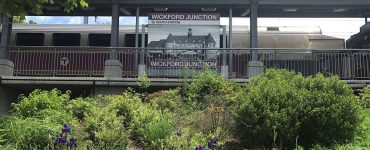
Luckily our connector is one stop on a line that runs from Boston and eventually past the airport onto Wickford Junction and maybe Westerly, New London, who knows… It is one of the good ones…

[...] with the Rhode Island DOT recently reaching a deal on its $267 million “Interlink” project, which entails building a station at the airport on an existing line, along with a commuter parking garage and a rental car facility. The station is only expected to see six trains a day initially, which is probably for the best since Providence’s T. F. Green Airport isn’t exactly O’Hare. No word on whether any additional density is being allowed around the new station, but something tells me the answer is no.

Sigh. The City of Warwick established the Warwick Station Redevelopment Agency years ago to guide development in the “Metro Center” area around the station. RIPTA is keen on transforming bus services in Kent County to focus transportation on the new station, making it a transit hub not just for air and rail, but for buses, further fueling the transit oriented development potential of the station area.

Yup, T.F. Green is not O’Hare, for that matter neither is Logan or BWI or LaGuardia or JFK or LAX. 6 trains a day, initially, yes. But once Wickford Junction opens next year, that number goes up. The Interlink is not about getting people to and from planes full stop, it is much more than that. It is a commuter link for Kent County and South County, it is an economic development tool for the City of Warwick and the airport.

Kevin Dillon, President and CEO of RIAC pointed out in rebutting Joe Paolino’s characterization of the Interlink as a “boondoggle” on GoLocalProv that low cost European carriers are looking at the northeast and at T.F. Green in particular. Why Green and not Bradley or Manchester? Because of the Interlink.

[airport connectors] are often a sort of cargo cult urbanism that seeks to emulate the frills of good transit systems isn’t willing to make the hard decisions necessary to actually build a robust network and allow the density to fill it. In the case of the the Providence airport, lawmakers said they hoped the station would attract international service to the currently domestic-only airport – as if Providence can acquire the amenities of a big city without allowing itself to become one.

There will undoubtedly be some NIMBY hurdles to overcome regarding density along the rail line, especially if we add a station in Cranston (can you imagine, denisty in Cranston!?), but the whole point of the southern push of commuter rail is to build density where it makes sense, along the transit line, and to aid people who live firther from it in leaving their cars somewhere other than downtown (or idling on the highway getting to downtown).

The line about Providence trying to attract big city amenities without actually allowing itself to become a big city… that I just don’t get. Again, there will always be NIMBYism surrounding growth, but I think political leaders, the business community, and a good deal of the citizenry would be more than happy to see the city become bigger. At the very least, if we grew it would be indicative of our economy emerging from the toilet.