Archives For Transportation

This morning at Bike to Work Day, Peter from RIPTA showed us how the Rack n’ Ride on the buses works.

bike002

bike003

Continue Reading…

mbta-providence-place

MBTA Commuter Rail passing under Providence Place. Photo (cc) Sean_Marshall.

Rhode Island recently spent a large sum of money to extend MBTA commuter rail service south to TF Green Airport and Wickford Junction. Both of them feature large parking garages (although the TF Green Interlink facility is for more than rail transit) that are not typical of suburban train stations and were very expensive.

These stations are only served by select trains on weekdays only, and feature long journey times to Boston – 1:35 from TF Green and 1:50 from Wickford Junction. Though these stations can be useful for commuting to downtown Providence – I’ve used the TF Green service for that myself – Providence is not nearly the employment market Boston is. What’s more, the Wickford Junction station is in a particularly inauspicious location.

Unsurprisingly, ridership is low. TF Green had about 200 passengers per day as of last summer, and Wickford Junction about 150.

With a mind-numbing total price tag of $100 million for this project (the estimated cost of just the transit portions) – almost $300,000 per rider – it’s unlikely that this will ever be viewed as a successful project.

As with the philosophy of the Boston area commuter rail generally, this service expansion was based on expanding the coverage area, but not the quality of service. In effect, it is an equity investment to make access to transit more equally available geographically (though economically more troubled areas like Pawtucket remain without service, so it doesn’t provide more economic equity).

While geographic equity is a legitimate government goal, public transit requires certain characteristics such as origin and destination demand, density of residences and employment, and walkable destinations in order to work well. It’s possible to add service to areas, but that does not mean it will be cost effective or well patronized.

Additionally, the South County expansions don’t move the needle for Rhode Island. One of the biggest challenges facing the area is of course the economy. In the Greater New England there are basically two main sources of wealth generation: New York and Boston. To the extent that you are in New England and are tied to one of those markets, you are generally succeeding. To the extent that you are cut off from them, you are struggling. The Providence area struggles because it is not as able to tap into the Boston economy given the just far enough distance between them by both car and transit.

Continue Reading…

kennedy-plaza-aerial-rendering

Rendering from Union Studio Architects

Update (Apr. 22): Union Studio News: Greater Kennedy Plaza

The Downtown Providence Parks Conservancy (DPPC) is set to unveil plans for the transformation of Kennedy Plaza in downtown Providence this evening.

Stakeholders in the downtown area including the City, the Parks Department, RIPTA, area businesses and universities, and others have been working on reimagining the plaza for the last 6 years. Over the past 12 months, through an “Our Towns” grant from the NEA, Union Studio Architects has led the process of finalizing that vision.

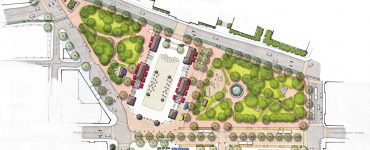
Among other improvements to be unveiled this evening, the plan calls for improving the bus operations at the heart of the plaza, Kennedy Plaza proper if you will. Through their on-going Comprehensive Operational Analysis, RIPTA has determined that schedule improvements will allow them to reduce the number of berths to 10. These 10 berths can be relocated to the edges of the plaza along Washington and Fulton Streets, allowing the bus-only lanes in the middle of the plaza to be filled in and turned to other public uses. Amy Pettine, RIPTA’s director of planning and marketing told The Providence Journal, “It will be a better experience for riders and a better environment.”

Improvements throughout the Greater Kennedy Plaza area (Biltmore Park, the Skating Center, Burnside Park, and the area from City Hall to the Court House) which will be fully released to the public tomorrow, include better integrating the Skating Center to the wider area allowing for better off-season (summer) use, raised roadways allowing for better pedestrian connectivity throughout the plaza and calming automobile traffic, and a Civic Plaza that DPPC Executive Director Cliff Wood calls a “front porch for City Hall.”

Reconfiguration of the bus stops and improvements infront of City Hall may be completed in 2014. Federal money the City has for roadway improvements would go toward this initial phase. This money is from the Circulator Project, which will be reconfiguring roadways between LaSalle and Emmet Squares this year. Wood told the Providence Journal that the entire project may cost as much as $20 million and depending on fundraising, could take 4 years to realize.

We’ll publish further specifics on the Kennedy Plaza plan tomorrow.

Full Disclosure: I am a member of the Downtown Providence Parks Conservancy Board.

ripta-hybrid

RIPTA to Hold Public Hearings on Proposed Service Changes Statewide

The Rhode Island Public Transit Authority (RIPTA) will hold public hearings on proposed service changes in all five Rhode Island counties on May 29th, May 30th, June 3rd, June 4th, June 5th, and June 6th. The Authority announced that the proposed changes in service statewide are a result of RIPTA’s ongoing Comprehensive Operational Analysis.

The Authority announced that the proposed changes in service statewide are part of RIPTA’s Comprehensive Operational Analysis. These changes include proposed new routes and express services, scheduling improvements to better coordinate routes operating in the same corridor, modified route alignments, frequency changes to better match service with demand, and the discontinuation of certain routes and route segments.

The Comprehensive Operational Analysis (COA) is a statewide review of transit services. The study has undertaken a detailed review process to identify where people live and work, how each bus route is performing today, and where changes might possibly be made to better serve riders. Proposed changes are designed to work within RIPTA’s existing budget, and the intent is to direct transit resources where they would be most effective.

“RIPTA’s staff and board of directors have appreciated the comments we have already received from our customers regarding proposed changes resulting from the Comprehensive Operational Analysis that we have undertaken,” said Mayor Scott Avedisian, chairman of RIPTA’s Board of Directors. “We certainly welcome additional comments and encourage residents to attend the public hearings that have been scheduled throughout Rhode Island in the next several months.”

The proposed changes would affect 56 regular bus routes and all Park and Ride service. Details on the proposed changes are available at RIPTA.com. Additionally, because ADA service is offered within a ¾ mile corridor of fixed-route service, the paratransit ADA service that RIPTA provides through the RIde Program would be adjusted to reflect the fixed-route changes.

ripta-public-hearings

To learn more about the COA, please visit the project website at RIPTA.com/featured-project

A 72-hour notice is required for persons with sensory impairment requiring auxiliary aids at public hearings. To request this service, members of the public should contact the RIPTA ADA Coordinator at 401-784-9553 (TDD) or 800-745-5555 (RI Relay TDD).

News & Notes

gcpvd —  April 17, 2013 — Leave a comment
OneFund-2Mayor Menino and Governor Patrick announced The One Fund Boston, to raise money to help those families most affected by the tragic events that unfolded during Monday’s Boston Marathon. To contribute to The One Fund Boston, go to theonefundboston.org.

→ The Atlantic Cities: How President Obama’s Budget Proposal Would Affect Cities

President Obama’s budget proposal for fiscal year 2014, released [last week], focuses on economic growth and a strong middle class. Better urban development isn’t the first item on that agenda, but it’s an important part of the administration’s priorities for the coming year.

Three agencies in particular are at the core of that work, with offices dedicated to making sure community development contributes to regional and national economic growth. The president’s 2014 budget would change how each of these agencies invest in community development.


→ The Atlantic Cities: New Chicago Plan: Pedestrians Come First

[I]n the Second City – as in just about every American metro – autos have long dominated city streets and how we think about who uses them, why they exist and what defines them as successful. This summer, though, Chicago is planning to roll out a small-sounding but seismic policy shift: From now on, in the design guidelines for every effort from major streetscape projects to minor roadside electrical work, transportation work must defer to a new “default modal hierarchy.” The pedestrian comes first.

Continue Reading…

This Streetfilms video highlights the fact that Americans are driving less; however, transportation planners continue to design our streets as if driving rates are going up. RIDOT, take note.

News & Notes

Jef Nickerson —  March 28, 2013 — Leave a comment

buffalo-metrorail

Buffalo Metro Rail – Photo (cc) Sean_Marshall

→ The Buffalo News: Development soars along Metro Rail

The Buffalo Niagara Medical Campus is spawning a housing boom along the Metro Rail line, as developers look to provide lofts and apartments for some of the 17,500 workers expected to be employed there.

Note their take on parking:

The new downtown cluster will provide enough parking for patients and visitors, according to Medical Campus President Matthew K. Enstice. But because the campus would rather spend its resources on medical facilities than parking garages, planners are encouraging the big new influx of employees to use public transportation.

“This is how you force culture change,” Enstice said. “We’re actually doing it.”

Plans call for bicycle racks placed at strategic locations, rental-car checkouts for employees, and an interconnected and walkable campus that will encourage thousands of people to live in the city near Metro Rail.

The plan “has to work” because there is no alternative, Enstice said. There is no room to park 17,500 cars on the 170-acre Medical Campus.

Also, read Stephen Miller’s take on how Providence needs to be taking heed of what Buffalo is doing:

You can have a vibrant small city, or you can have cheap, ample parking in and around downtown. You cannot have both, for the simple reason that parking takes up a lot of space that would otherwise be used by people doing economically productive things. Buffalo seems to have learned this lesson. Providence, meanwhile, is drowning in downtown parking as the metro area’s economy stagnates.


Continue Reading…

taveras

Mayor Taveras unveiling his economic development plan this morning. Photo from the Mayor’s Facebook page

Mayor Taveras is unveiling his Economic Development Reportpdf.

Update: Media reports

Update: Press release from the Mayor’s Office

Pledging Action, Mayor Taveras Outlines Plan to Grow Providence’s Economy

‘Putting Providence Back to Work’ report presents roadmap to improve the business climate, infrastructure and human capital in Rhode Island’s Capital City

PROVIDENCE, RI – Mayor Angel Taveras today announced a 20-step economic development action plan to put Providence residents back to work and jumpstart the economy of Rhode Island’s Capital City.

The Mayor said that Providence’s economy must be built on the success of a broad range of industries and sectors, and pledged swift action to improve Providence’s business climate, infrastructure and human capital.

“When we work together, we can compete head to head with any city or state in this country,” said Mayor Taveras. “Nothing will change minds about Providence as much as continuing our track record of success.”
The Mayor outlined five immediate steps his administration will pursue to support and grow Providence’s economy:

  1. Freeze the commercial tax rate – The Taveras administration will work with the Providence City Council to enact a seven-year commercial real estate tax freeze that guarantees consistency and stability for developers in Rhode Island and beyond.


    “Freezing our commercial property tax rate will send a message that Providence is serious about attracting new business. We look forward to the day when economic growth in our City enables us to actually lower Providence’s commercial rate,” Mayor Taveras said.
  2. Fix the City’s Permitting Process – Contained in the FY14 budget that Mayor Taveras will present to the City Council next month are two positions to staff a new unit in the Department of Inspections and Standards focused solely on reviewing and approving small-permit applications of under $100,000. These small projects account for 75 percent of all permit applications in the City.


    Additionally, this summer the City will move its permit application process online. For the first time, developers will only need to log onto the City’s website to apply for a permit and get status updates on their applications.
  3. Remove Barriers to Redevelopment – The City will conduct an inventory of all major properties in need of redevelopment. For properties that are not defined as historic landmarks, the City will put on a fast-track for approval all projects to replace existing structures with new construction.

    “We recognize that the City has an important role to play in facilitating new development. It is time to get cranes in the air and put people to work rebuilding our city,” Mayor Taveras said.
  4. Develop Surface Lots Citywide – To stimulate real estate development and ease the crunch on parking downtown, the Taveras administration will work with the City Council to provide tax stabilizations to developers who commit to new development on existing surface lots. New construction on an existing lot will be taxed based on the property’s current assessed value. This program will create jobs, incentivize new, mixed-use developments, and spur new investment on Providence’s major commercial corridors.
  5. Reinvent Kennedy Plaza – The City will work with the Downtown Providence Parks Conservancy, RIPTA and other public and private partners to reconfigure and reduce the number of buses in the Plaza and transform it into a pedestrian destination.

Continue Reading…

Battleship Cove

Fall River

As part of attempts to restore service to Tiverton and Little Compton, RIPTA is looking into strategies to connect that service to SRTA in Fall River.

Legislators ask for federal waiver to connect potential RIPTA route to Fall River bus line

STATE HOUSE – Four state senators and representatives from Aquidneck Island have sent a letter to the Rhode Island Congressional delegation, requesting their assistance in allowing the Rhode Island Public Transit Authority (RIPTA) to receive a waiver of insurance for interstate travel between Rhode Island and Massachusetts.

Representatives John G. Edwards (D-Dist. 70, Portsmouth, Tiverton) and Dennis M. Canario (D-Dist. 71, Portsmouth, Little Compton, Tiverton), as well as Senators Christopher S. Ottiano (R-Dist. 11, Portsmouth, Bristol) and Walter S. Felag Jr. (D-Dist. 10, Warren, Bristol, Tiverton), have been engaging in discussions with RIPTA for the past year with the hope that the authority will return service to Tiverton. Currently in discussion is a proposal to create a more profitable route that could connect to a Massachusetts bus line in Fall River, which RIPTA officials say requires a waiver at the federal level.

The letter states: “RIPTA, as you are aware, is self-insured. For them to carry insurance beyond their own would be cost prohibitive and would effectively kill any sort of connection to the SRTA system. The staff at RIPTA has told us that they would only drive into Fall River MA for approximately a half mile to make the connection and turn around their busses”

In September, Representative Edwards sent a letter to RIPTA Chairman Scott Avedisian – also the mayor of Warwick – expressing his concern about the lack of RIPTA’s presence in his district, pointing out that public transportation and infrastructure is a crucial “instrument of job growth” and benefits other areas of importance like “education, daycare and general livability”

News & Notes

gcpvd —  March 21, 2013 — Leave a comment

IMG_1606

Aftermath of Hurricane Sandy in Matunuk. Photo © RIDOT

→ The Atlantic Cities: Even More Evidence Climate Change Will Hit East Coast Cities Particularly Hard

Batten down the hatches, East Coasters: A new study argues that for every one degree Celsius (1.8 degrees F) of global warming, the American Atlantic seaboard could see up to seven times as many Katrina-sized hurricanes.

Oh, yay!


→ Mobilizing the Region: Poll Finds Support for Tolls In Connecticut

The majority of Connecticut voters support the return of tolls on state highways — under certain conditions — according to the latest poll from Quinnipiac University. While 58 percent generally oppose tolls on Connecticut highways, 57 percent would support them if the toll revenue were to be used to repair the state’s roads and bridges.


Continue Reading…