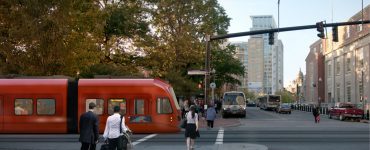
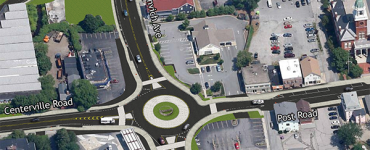
This video rendering shows what the vision for Greater Kennedy Plaza could look like as you move through it.
Archives For Streetcar
The Seattle Transit Blog reports that Amazon.com, which is building a shiny new headquarters complex in Downtown Seattle, plans to buy that city a new streetcar vehicle for service on an existing line and provide funding for shorter headway service.
The overall proposal includes $5.5 million of support for the Seattle Streetcar. This funding will allow the City to purchase an additional streetcar vehicle and increase operational support for 10 years as a part of the Planned Community Development benefit package. In total, these benefits will increase street car service to every ten minutes during the workday.
They will also be building other pedestrian and cycling enhancements in the area. Apparently all this is in exchange for the taking of a number of public alleys the company needs to construct it’s headquarters.
Imagine if we called on developers to give concessions to receive zoning variances and street abandonments.
More information at:
ArlingtonVA.tv
arlingtonva.us/streetcar
→ DC Streetsblog: Oregon Takes the Next Step in Moving Beyond the Gas Tax
Rep. Earl Blumenauer likes to say that Oregon was the first state to adopt a gas tax and it will be the first state to get rid of it. In 2006-2007, the state conducted a pilot study of alternative revenue collection methods, with an eye toward moving to a better system. This fall, they’ll do another pilot, fine-tuning their process for replacing the gas tax with a vehicle-miles-traveled fee.
→ The Guardian: Paris to return Seine to the people with car-free riverside plan
The pedestrianisation of one of Europe’s most picturesque urban riversides means the death knell for the Seine’s non-stop riverside expressways. These were the pride of Georges Pompidou in the 60s when France’s love affair with the car was at its height. Opened in 1967 by him, under the slogan “Paris must adapt to the car”, the dual carriageway with perhaps the best view in France allowed a speedy crossing of Paris from west to east. But environmentalists have long complained it was a dreadful, polluting waste of architectural heritage.
Continue Reading…
The former Interstate-195 lands need a transportation plan as only seven of the 23 parcels slated for redevelopment there can accommodate a building with sufficient on-site parking, a consultant told the I-195 District Commission Monday.
John Chambers, a civil engineer with Fuss & O’Neil Inc., said because so many parcels are “odd-shaped lots” that do not have space for a building and garage, coming up with a transportation strategy for the district would be needed to maximize development value.

DMU train in Luxumbourg. Photo (cc) bindonlane
This post was submitted Greater City: Providence reader Peter Brassard. If you’ve written something you’d like us to consider posting, please contact us and let us know.
Rhode Island’s commuter rail service as currently conceived may not be conducive to encouraging ridership. Distances between existing and proposed stations are too far. Much of the focus has been on extending the system further into low-density suburbs. For Rhode Island commuter rail to succeed, more needs to be done to take advantage of existing walkable urban neighborhoods that have a high potential for passengers. Some of these areas have large amounts of commercial/industrial space or development opportunities. Due to Downtown Providence expansion, the rail system will be challenged, as long as there’s no internal downtown high-frequency transit, such as the proposed Core Connector, to directly link rail passengers to the far reaches of downtown.
Rhode Island’s commuter rail doesn’t capitalize on density variations and neighborhood assets of the Providence area. If Rhode Island’s commuter rail functioned as a rapid mass-transit system, besides increasing the number of passengers, it would help to revitalize and expand development opportunities for neighborhoods along the rail line. The implementation of medium frequency shuttle train service within the Rhode Island instate rail corridor would offer predictable headway times at regular intervals that could operate in addition to MBTA commuter and Amtrak trains. Air and intercity train travelers, commuters, and the general public would greatly benefit from this level of service.
A variation to a commuter rail or shuttle train is the German S-bahn or French RER or San Francisco’s BART. An S-bahn type system is usually the same as commuter rail in suburban areas, but differs when it’s within the central urban core, where it has characteristics of a subway or metro. Usually stations within the core zone are located close together at quarter- to half-mile subway station distances and schedule headway times typically fall somewhere in the middle of commuter rail and subway schedules. Depending on the city, central core rail infrastructure can be underground or at grade utilizing existing rail corridors. A hybrid of a shuttle train and an S-bahn might be best for Rhode Island.

Recently, RIDOT received $3 million dollars in Federal high speed rail funds for renovations at Providence Station. Among the items that money is set to be spent on is renovations and repairs to the exterior of the station.
We’ve received plans for those renovations and were less than thrilled.
Click image to enlarge
Providence Station is 26-years-old. Lack of routine maintenance aside, when buildings are approaching their 30th birthday, it often is time for renovations, and those renovations offer a chance to reassess the building, to make changes to bring it into line with conditions that weren’t present when the building was constructed.
In 1986, when Providence Station opened, rail travel was on the wane. Gas cost 93¢ per gallon, the MBTA did not serve Providence, there was no Amtrak Acela service, Capital Center was still on the drawing board, and no one was talking about streetcars in Providence. Basically it was built because cities are supposed to have train stations.
Berlin Dynamic from Matthias Makarinus on Vimeo.
→ Vimeo: Berlin Dynamic
Dynamic Berlin – Timelapse project with over 50.000 photos and thousands of people. Dynamic light, clouds, street life, movement and much more. Shot from May 2010 – September 2011 with Canon 5D Mark II and many lenses.
Via: The City Fix
→ The Hill: Boxer sees ‘no path forward’ on $109B Senate transportation bill
The Senate transportation bill, which is shorter than the controversial House version of the measure, has been hailed for its bipartisanship since was approved unanimously by several committees. The Senate bill does not include provisions to expand oil drilling, but it has been bogged down amendments such as a measure from Sen. Rand Paul (R-KY) dealing with foreign aid to Egypt and an effort to contraception in their healthcare plans.
Boxer said Wednesday that she would not allow the transportation bill to be permanently stopped during the amendment process.
Continue Reading…